Posts

In what ways were the pre-Indus (5000-2600 BCE) and post Indus (1900-1200 BCE) periods different from the Indus period (2600-1900 BCE)?

Image
source: https://indusvalley-harappa.weebly.com/uploads/3/9/0/6/39066825/header_images/1410361819.jpg The Indus period (2600-1900 BCE) often referred to as the Harappan civilization is amongst the oldest civilization known today, the other being the Mesopotamian and Egyptian civilization. The absence of its mention in the literary accounts and the non-decipherment of its script has left us with archaeology as the only field to give some proven insights on the period. But with archaeology with its own limitations pertaining to excavation and differences on interpretation of artefacts provide us with only limited knowledge leading to no concrete notion about the period. Thus, it becomes a challenge to compare and demarcate it with surrounding ancient cultures with no uniform notion which can be decided upon. The enlightenment years and the start of colonialism in India prepared a ground for a spirit of inquiry about India’s past leading to exploration works in the early 19 th century. ...

The shifts in the interpretation of term Aryan

Image
Source: https://www.ancient-origins.net/sites/default/files/field/image/The-True-Aryans.jpg The present historical hypothesis in defining the word ‘Aryan’ is mainly based upon historiography, archaeology, linguistics, comparative mythology, social anthropology and more recently, genetics. The emergence of new disciplines enhancing research, availability of more archaeological data, advances in the study of historical linguistics, etc can led to changing prevalent notions. It goes while interpreting the term “Aryan”. No doubt the term is a politicized word which further leads to emergence of more theories and myths associated with it. And as Dorothy M. Figueira correctly points out, History, once transformed into myth, becomes an instrument to construct social forms. It shapes the present through an evocation of the past and specific groups that inhabit it. [1] The effort to define the word which began with the 1 st reading of Vedas, still continues to do so. The issue of Aryan i...

What was the Nagara style of temple architecture ?

Image
Source:  https://www.india.com/travel/articles/5-magnificent-temples-that-will-draw-you-to-odisha-this-january-3241071/ The Nagara Style temple architecture in India The Nagara style is mainly associated with the land between the Himalayas and Vindhyas. According to Peter Hardy, ''Nagara and Dravida (another style of architecture in South In dia) should be understood as architectural languages, in the sense that they provide a vocabulary, a range of elements, and a family of forms which can be put together in different ways." The basic plan of Nagara temple is square, with a number of graduated projections ( rathakas ) in the middle of each face which gives it a cruciform shape in the exterior. A temple tower or a conical or convex  shikhara  marks the elevation of th...

Al-Beruni and the Kitab al-Hind

Image
Source: https://pecihitam.org/al-biruni-ilmuwan-muslim-penghitung-pertama-kali-keliling-bumi/ Abu Raihan Muhammad ibn Ahmad commonly known as Al-Beruni was born in in A.D.973 in the territory of Khwarizm, then under the control of the Samanid ruling dynasty of Transoxiana and Persia. Beruni is a Persian word meaning or belonging to outside. As Al-Beruni was born outside the city in a suburban area he was given epithet of Al-Beruni. Al-Beruni was a Muslim of Iranian origin and was a great linguist and a prolific writer. Besides his mother tongue Khwarizmi, he knew Persian, Arabic, Hebrew, Syriac and Sanskrit. He had no direct knowledge of Greek but he was well acquainted with the works of Plato and other Greek masters. He is referred to in the works of some near contemporary writers as ‘alustadh’ or ‘the master’. (H.A.R. Gibb; J.H. Kramers 1986, 1236) In words of Abu’l Fazl Baihaqi, a near contemporary: “Bu Rihan was beyond comparison, superior to every man of his time in the art ...

Megalithic Cultures of Central India and Deccan during the period circa 1000 B.C.E TO 300 B.C.E

Image
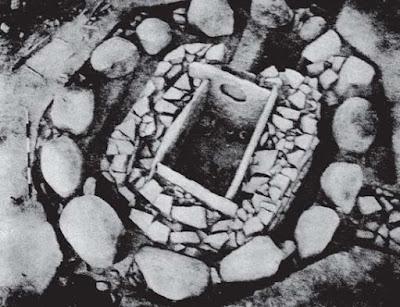
The term ''megalithic'' is derived from the Greek words,  megas which means huge or big and lithos, i.e stone. But unlike the 'palaeolithic',  'microlithic',  'neolithic', or 'chalcolithic' it does not refers to classes of tools rather 'megalithic' refers to the ritual use of stone as stationary symbols or guardians of a site. In south India, the stones were exclusively associated with burials i.e the stones were erected in the memory of the dead. The Megalith monuments have been found in many parts of the world and in the Indian subcontinent, they occur in far south, the Deccan plateau, the Vindhyan and Aravali ranges, and the north-west. Megalithic burial The Megalithic monuments reveal a great variation in their forms and structure, yet they represent, in the Indian context, a homogeneous culture dominated by two key elements- a) use of iron tools and weapons and, b) familiarity with a polished and well-fired pottery cal...

PALAEOLITHIC CULTURES OF INDIA

Image
The idea of three age system(stone, bronze and iron) was first put forward in the late 18th century and early 19th century by the Danish scholars P.F.Suhm and Christan Thomsen.The Palaeolithic period or the Old Stone Age constitutes the longest phase of Prehistory and covers the whole range of the Pleistocene epoch from about 2 m.y.a to 10,000 BP. The Palaeolithic Age is divided into three cultural phases, Early or Lower Palaeolithic, Middle Palaeolithic and Late or Upper Palaeolithic. The division was suggested by Edouard Lartet based on progressive improvement in tool-types. The Lower Palaeolithic period was marked by the use of heavy pebble tools(chopper-chopping and hand-axes), the Middle Palaeolithic by flake tools and Upper Palaeolithic by sharp blades and burins. CHRONOLOGY: The earliest fossils relating to human evolution have been found in the shiwalik hills covering India and Pakistan. These fossils are skulls called Ramapithecus and Shivapithecus which are consid...